Crime Causation: Sociological Theories - Strain Theory, Social Learning Theory, Control Theory, Labeling Theory, Social Disorganization Theory, Critical Theories
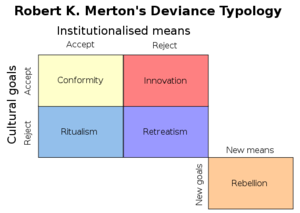
This entry focuses on the three major sociological theories of crime and delinquency: strain, social learning, and control theories. It then briefly describes several other important theories of crime, most of which represent elaborations of these three theories. Finally, efforts to develop integrated theories of crime are briefly discussed.
All of the theories that are described explain crime in terms of the social environment, including the family, school, peer group, workplace, community, and society. These theories, however, differ from one another in several ways: they focus on somewhat different features of the social environment, they offer different accounts of why the social environment causes crime, and some focus on explaining individual differences in crime while others attempt to explain group differences in crime (e.g., why some communities have higher crime rates than other communities).
Additional Topics
Why do people engage in crime according to strain theory? They experience strain or stress, they become upset, and they sometimes engage in crime as a result. They may engage in crime to reduce or escape from the strain they are experiencing. For example, they may engage in violence to end harassment from others, they may steal to reduce financial problems, or they may run away from home to escape…
Why do people engage in crime according to social learning theory? They learn to engage in crime, primarily through their association with others. They are reinforced for crime, they learn beliefs that are favorable to crime, and they are exposed to criminal models. As a consequence, they come to view crime as something that is desirable or at least justifiable in certain situations. The primary v…
Strain and social learning theorists ask, Why do people engage in crime? They then focus on the factors that push or entice people into committing criminal acts. Control theorists, however, begin with a rather different question. They ask, Why do people conform? Unlike strain and social learning theorists, control theorists take crime for granted. They argue that all people have needs and desires …
The above theories examine how the social environment causes individuals to engage in crime, but they typically devote little attention to the official reaction to crime, that is, to the reaction of the police and other official agencies. Labeling theory focuses on the official reaction to crime and makes a rather counterintuitive argument regarding the causes of crime. According to labeling theor…
The leading sociological theories focus on the immediate social environment, like the family, peer group, and school. And they are most concerned with explaining why some individuals are more likely to engage in crime than others. Much recent theoretical work, however, has also focused on the larger social environment, especially the community and the total society. This work usually attempts to e…
Critical theories also try to explain group differences in crime rates in terms of the larger social environment; some focus on class differences, some on gender differences, and some on societal differences in crime. Several versions of critical theory exist, but all explain crime in terms of group differences in power. Marxist theories. Marxist theories argue that those who own the means of prod…
The above theories focus on the factors that create a general willingness or predisposition to engage in crime, locating such factors in the immediate and larger social environment. People who are disposed to crime generally commit more crime than those who are not. But even the most predisposed people do not commit crime all of the time. In fact, they obey the law in most situations. Several theo…
Several theorists have attempted to combine certain of the above theories in an effort to create
integrated theories of crime. The most prominent of these integrations are those of Terence P. Thornberry and Delbert S. Elliott and associates. Elliott's theory states that strain and labeling reduce social control. For example, school failure and negative labeling may threaten one's …
Sociologists continue to refine existing theories and develop new theories of crime, including integrated theories of crime (e.g., Charles Tittle's control balance theory). Sociologists, however, are coming to recognize that it is not possible to explain crime solely in terms of the immediate social environment. As a consequence, they are devoting more attention to the larger social environ…
Citing this material
Please include a link to this page if you have found this material useful for research or writing a related article. Content on this website is from high-quality, licensed material originally published in print form. You can always be sure you're reading unbiased, factual, and accurate information.
Highlight the text below, right-click, and select “copy”. Paste the link into your website, email, or any other HTML document.
User Comments Add a comment…
about 1 year ago
Mike » michaelgrosu ((at)) gmail dot com
Awesome website, everything is explained in a simple way and easy to understand. This helped me a lot with my essay. However they need to include the subcultural theory as well, because that took me a while to understand.
over 1 year ago
d.heck » dheck50 ((at)) yahoo dot com
this is cool!
over 1 year ago
lani » jhulean_1384 ((at)) yahoo dot com
i am suppose to conduct a research on theories on crime causation and what are the theories that is being used by the police in the enforcement of law
hope that this site is available for information.
in case that you can help me please contact me via my email add posted
almost 2 years ago
Barb J » richtrrailer ((at)) yahoo dot com
Sweeeet! My professor is very vague and the text book is long, dry and boring! This site explained in short, simple, human english what the topic is about. Now I can work on my final without hair pulling and nail biting! Thanks!
almost 2 years ago
Wendy » wendyholden ((at)) hotmail dot com
Awesome website; it helped me with my essay! Thank you!
almost 2 years ago
eizer » blackmans23 ((at)) yahoo dot com
This a GREAT website..that help me in my term paper.. THANK YOU VERY MUCH...!!!!
about 2 years ago
Kim » jtwench_1999 ((at)) yahoo dot com
GREAT! Exelent! Thanks....
about 2 years ago
Kim » JTwench1999 ((at)) yahoo dot com
Thanks! This is great for my homework.
about 2 years ago
Tommy » stratman2001 ((at)) hotmail dot com
This is a good run-down of Crime theory.
about 2 years ago
Eddie » eddie_cardona ((at)) att dot net
why is social control theory and social learning theory are important to a crime analyst?