Baby Richard Trial: 1991-95
Illinois Legislature Gets Involved
The Illinois Supreme Court's decision's unpopularity led to an immediate convening of an emergency session of the state legislature, which at once passed a retroactive law requiring a custody hearing in the case. This led Kirchner to seek a writ of habeas corpus from the Illinois Supreme Court to gain custody of the child, and the Illinois court promptly granted Kirchner's request. At the same time the court took the legislature to task for trying to reverse, by statute, the court's earlier decision.
The Illinois Supreme Court's second ruling in favor of Kirchner, however, was not unanimous. Breaking away from her peers on the court, Justice Ann G. McMorrow, who had sided with the majority in the first decision, now dissented, denouncing the judicial system that had let the case drag on for four years. She was to be only one of many critics of Baby Richard's court-decreed fate. It was popularly believed that the system had failed Richard; but the court was not alone in the blam—Kirchner, Daniella, the Warburtons and their attorney who had known of Kirchner's existence, social workers, the press—everyone seemed to have played a part in the unpopular ruling.
On April 30, 1995, amid a media circus, Kirchner and Daniella arrived at the Warburtons' house and took Richard home with them. Richard cried pitifully and begged the Warburtons not to make him leave. Kirchner and Daniella later married, but in January 1997 Kirchner moved out, leaving Daniella and Richard—now known as Danny Kirchner—for another woman.
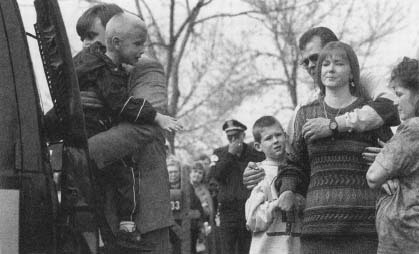 Otakar Kirchner (left) carries his son known as 'Baby Richard,' as the boy's foster family grieves.
The Baby Richard case epitomized the American legal system at its worst. It was a sorry story of long judicial delay that made the ultimate decision ever harder on Richard; an unpopular decision that called the legal system's legitimacy into question; and an episode that pitted the judiciary against the political branches of government. Most important, it revealed that traditional American notions of stable families consisting of two married parents raising their own biological children was a simplistic view of modern family life.
—Buckner F. Melton, Jr.
Suggestions for Further Reading
Zito, Anthony S. "Baby Richard and Beyond: The Future for Adopted Children." Northern Illinois University Law Review (Summer 1998): 445-79.
Additional topics
Law Library - American Law and Legal InformationNotable Trials and Court Cases - 1989 to 1994Baby Richard Trial: 1991-95 - Father Attempts To Gain Custody, Illinois Legislature Gets Involved